
Attorney Ben Crump Reveals Nolan Wells' Independent Autopsy Results – and the Report Ends with 7 Unanswered Questions
July 23, 2026


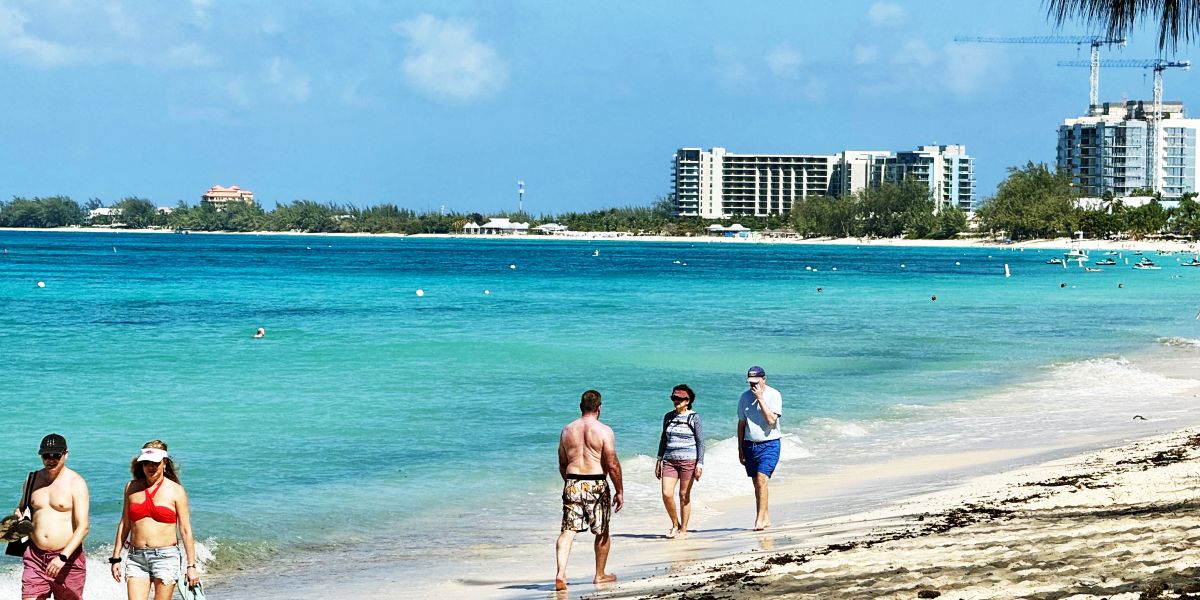

A violent shake beneath the sea jolted the Caribbean late Saturday, leaving experts scrambling to assess the full extent of the danger. As the waves begin to roll in, some coastlines brace for impact.
A massive earthquake, measuring 7.6 on the Richter scale, struck the Caribbean Sea late Saturday, triggering tsunami warnings for several coastal regions. The quake occurred at 23:23 UTC on February 8, 2025, with its epicenter located at 17.8°N, 82.5°W, and a depth of 33 km (20 miles).

Tourists in Grand Cayman, Cayman Islands | Source: Getty Images
Following the earthquake, tsunami waves were detected, prompting an alert for certain coastal areas. According to the Pacific Tsunami Warning Center (PTWC), hazardous waves between 1 to 3 meters above tide level are expected along Cuba's coast. Smaller waves, ranging from 0.3 to 1 meter, may impact parts of Honduras and the Cayman Islands.
Authorities are closely monitoring sea-level gauges to assess the full extent of the tsunami risk. The PTWC emphasized that actual wave heights may differ due to local geography and underwater terrain. Barrier reefs and atolls may experience significantly lower impacts than forecasted.

A picturesque beach in Cuba with golden sand and turquoise waters | Source: Pexels
The first tsunami waves are expected to reach affected regions within hours on February 9. Estimated arrival times (UTC) include:
A tsunami is not a single wave but a series of surges. Some waves may be larger than the initial one, with intervals ranging from five minutes to an hour. The threat could persist for several hours or longer.

A giant wave | Source: Pexels
Officials have confirmed that no tsunami warning has been issued for the United States. However, coastal monitoring will continue as a precaution. Governments in the affected regions are advising coastal residents to stay alert and follow instructions from local officials. Evacuations may be necessary in certain areas, depending on the severity of the waves.
The U.S. Geological Survey (USGS) also acknowledged the quake in a social media post, stating, "Notable quake, preliminary info: M 7.6 - 209 km SSW of George Town, Cayman Islands."
Hours after the powerful earthquake rocked the Caribbean, the U.S. National Tsunami Warning Center issued key updates, easing concerns in some regions while maintaining caution in others. In a series of social media posts, the agency confirmed that the tsunami threat had passed for the United States and its international partners.
One update stated, "With the latest modeling and information, the tsunami threat has passed. There are no alerts posted for the United States or International Partners. The agency concluded, “Unusual currents may be noticed in some areas. Exercise normal caution."

Aerial view of the ocean | Source: Pexels
Despite this, alerts remained in place for certain locations. Another update highlighted ongoing monitoring for Cuba, Honduras, and the Cayman Islands. Officials reported that a small tsunami wave—measuring 3 cm (1.2 inches)—was recorded near Isla Mujeres, Mexico, at 01:03 UTC. While minor in size, the reading confirmed that tsunami activity had occurred.
Meanwhile, a third update brought relief to residents of Puerto Rico and the U.S. Virgin Islands, announcing that the tsunami advisory for these regions had been canceled. However, officials warned that strong and unusual currents could persist and urged people to remain cautious near the water.
As tsunami warnings rippled across the Caribbean, the Bahamas Department of Meteorology issued a special weather statement cautioning coastal communities about potential impacts.
The advisory, released at 7:45 PM EST on February 8, 2025, noted that the 7.6-magnitude earthquake struck approximately 130 miles south-southwest of George Town, Cayman Islands. In response, the Pacific Tsunami Warning Center (PTWC) issued alerts for several nations across the Caribbean, Central America, and South America.
Officials warned that elevated sea levels could affect parts of the Southeast Bahamas, including Ragged Island, Crooked Island, Acklins, Mayaguana, and Inagua. The advisory also extended to the Turks and Caicos Islands.
Residents along eastern and southern shorelines in these areas were urged to remain vigilant between 7:30 PM and 9:30 PM EST for any unusual changes in coastal conditions. Authorities continue to monitor the situation, advising residents to stay informed through official weather updates.
Attorney Ben Crump Reveals Nolan Wells' Independent Autopsy Results – and the Report Ends with 7 Unanswered Questions
July 23, 2026

Meghan Markle Turns 45: What King Charles Is Expected to Do — and Why William and Kate Are a Different Story
August 04, 2026

Donald Trump Delivers Tribute for Lindsey Graham — But One Moment at the Funeral Has Netizens Talking
July 29, 2026

George and Amal Clooney Share an Emotional Message as They Flee Their French Farm amid Wildfires — Details
July 30, 2026

'Godzilla vs. Kong' Actress Kaylee Hottle Dies at 19 in Maryland Car Crash — Details Emerge About Who Was With Her
July 22, 2026

Senator Mitch McConnell Seen on a Stretcher in Ambulance Video — Witnesses Detail What They Noticed About His Feet
July 11, 2026

Dispatch Audio Reveals What First Responders Found When They Arrived at the Scene of the Crash Involving Kaylee Hottle
July 22, 2026

Nolan Wells' Close Friend Breaks Down What Really Happened in the Viral Beach Video – and What It Reveals
July 15, 2026

Simone Biles Details 'Scariest Experience' — Photos
June 07, 2026

Mitch McConnell's Health Update Comes as Emergency Dispatch Records Detail the Morning of His Hospitalization
July 06, 2026

Christine Wonsley Received a Mysterious Letter – What Was Inside and What She Had to Say About It
July 20, 2026