
Antoine Forest, Jazz Aviation Hero Pilot, Sparked Buzz with Emotional Instagram Post – Photo
March 24, 2026



Nine seconds. That's all the time a LaGuardia air traffic controller had to stop a fire truck from crossing a runway — with an Air Canada jet already on the ground.
The deadliest collision at LaGuardia Airport in more than three decades unfolded in under three minutes — a blur of overlapping emergencies, blocked radio transmissions, and a stop order that came too late.
Federal investigators have now reconstructed almost every second of what happened, and the picture is damning.
What the timeline reveals is that the collision was the final link in a chain that had been forming for nearly an hour. At the center of it all is one question that remains unanswered: Did the crew of the fire truck ever hear the order to stop?

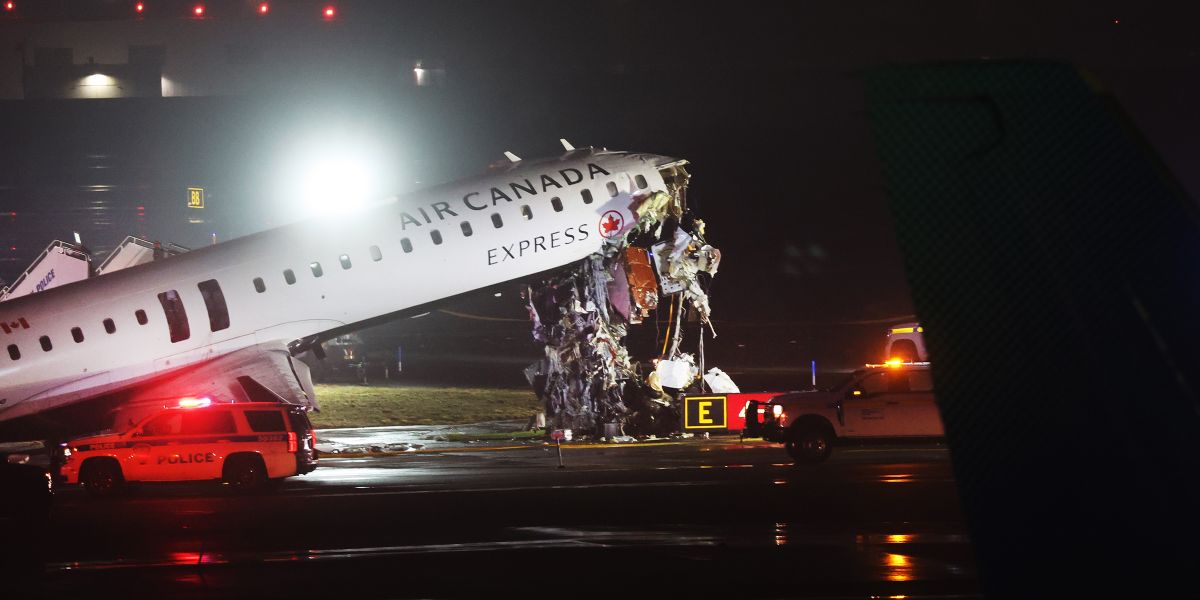
The crash site after the Air Canada plane incident at LaGuardia Airport in New York City on March 23, 2026. | Source: Getty Images
Long before Air Canada Express Flight 8486 began its final descent, the LaGuardia control tower was already stretched thin.
United Airlines Flight 2384, bound for Chicago, had been sitting on the tarmac for over two hours when it aborted its first takeoff attempt at 10:40 p.m. It then aborted a second attempt roughly 40 minutes later.

Emergency personnel around the tarmac after an An Air Canada Express plane colliding with a fire truck at LaGuardia Airport | Source: YouTube/KHOU 11
At 11:31 p.m. — just minutes before the collision — the United flight declared an emergency, reporting that an onboard odor had made members of the flight crew ill and requesting an immediate gate assignment.
Four minutes later, it was assigned a gate and told to wait for emergency responders. That unfolding crisis meant air traffic controllers were already managing an active emergency when the Air Canada jet began its approach.
According to the National Transportation Safety Board, what followed was a timeline in which every second counted and not enough remained.

Emergency personnel around the tarmac after an An Air Canada Express plane colliding with a fire truck at LaGuardia Airport on March 23, 2026, in New York City | Source: YouTube/KHOU 11
At 3 minutes and 7 seconds before impact, the approach controller instructed the Air Canada crew to switch over to the LaGuardia tower frequency.
The flight crew lowered the landing gear at the 2-minute-45-second mark and checked in with tower control 22 seconds after that.
At 2 minutes and 27 seconds out, the tower cleared the aircraft to land on Runway 4 and advised the crew they were second in line. The crew adjusted the flaps twice — first to 30 degrees, then to 45 — as the plane dropped steadily toward the ground.

Emergency personnel around the tarmac after an An Air Canada Express plane colliding with a fire truck at LaGuardia Airport on March 23, 2026, in New York City | Source: YouTube/KHOU 11
One minute and 26 seconds before the crash, the plane's enhanced ground proximity warning system issued an electronic "1,000" callout, confirming the aircraft was now 1,000 feet above the runway.
At the 54-second mark, the crew acknowledged they were at 500 feet and on a stable approach.

The accident site is seen at LaGuardia Airport after an Air Canada plane collided with a fire truck while landing on March 23, 2026, in New York City | Source: Getty Images
At 40 seconds out, the tower asked which vehicle needed to cross a runway — a question tied directly to the ongoing United Airlines emergency.
A Port Authority rescue and firefighting vehicle, identified in radio communications as "Truck 1," needed to get across Runway 4 at Taxiway D.
At the 28-second mark, Truck 1 made its radio transmission. Two seconds later, the tower acknowledged it. At 25 seconds out, the truck formally requested to cross Runway 4 — the exact runway where the Air Canada jet was now in its final approach.

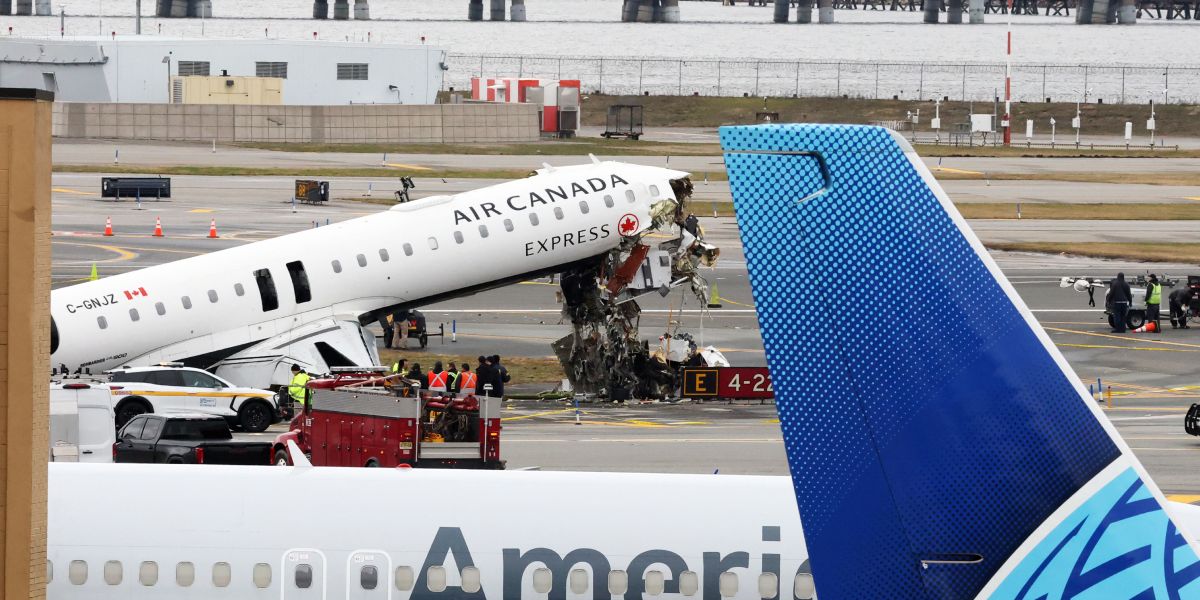
The accident site is seen at LaGuardia Airport after an Air Canada plane collided with a fire truck while landing on March 23, 2026, in New York City | Source: Getty Images
The plane was already 100 feet off the ground when the tower granted clearance. Twenty seconds before impact, the controller cleared Truck 1 and the company to cross.
One second later, the electronic callout confirmed the Air Canada plane was at 100 feet. Seventeen seconds out, Truck 1 read back the crossing clearance — the mandatory step to confirm both the controller and the vehicle crew had the same understanding.
The plane, meanwhile, was descending fast. Electronic callouts ticked down in the cockpit: 50 feet. 30 feet. 20 feet. 10 feet.

An Air Canada Express plane sits on the tarmac after colliding with a fire truck at LaGuardia Airport on March 23, 2026, in New York City | Source: YouTube/KHOU 11
LaGuardia's Runway 4 is equipped with a Runway Status Lights system — red lights embedded in the pavement that automatically activate when high-speed traffic is on or approaching the runway.
By design, those lights can go dark for a brief window just before a landing plane passes a taxiway intersection. The truck may have entered the runway in exactly that window.

Passenger plane collides with a fire truck while landing at LaGuardia Airport on March 23, 2026, in New York City, New York | Source: Getty Images
Nine seconds before impact, the tower issued a direct order: "Stop, stop, stop, stop, Truck 1, stop, stop, stop."
At the 8-second mark, sounds consistent with the plane's landing gear hitting the pavement could be heard in the cockpit voice recorder audio.
Four seconds before the collision, the controller issued the command once more: "Stop, Truck 1, stop!" Other vehicles behind Truck 1 did not proceed onto the runway. At zero seconds, the recording ends.

An Air Canada Express plane sits on the tarmac after it collided with a fire truck on the tarmac at LaGuardia Airport on March 23, 2026 | Source: Getty Images
While both Air Canada pilots were killed and dozens were injured, one crew member's survival has drawn its own remarkable attention. Flight attendant Solange Tremblay was seated in her jump seat when the jet T-boned the fire truck.
The force of the impact ejected her more than 300 feet from the aircraft — yet rescuers found her still strapped to the seat, alive, with a fractured leg.
Former federal crash investigator Jeff Guzzetti credited the outcome to the seat's four-point restraint design, describing it as bolted to the same wall the cockpit utilizes — built specifically to withstand this kind of impact.
What makes her survival even harder to explain away is something she posted on Facebook almost exactly three years before the crash.
On March 15, 2023, Tremblay wrote: "Mirror, mirror on the wall, I will get up after I fall. Whether I run, walk, or crawl, I will set my goals and achieve them all." It reads, in retrospect, less like a motivational caption and more like a forecast.
The NTSB has not yet determined whether the Truck 1 crew heard the repeated stop commands before the collision.
It also remains unclear why a flight attendant warned passengers to leave their luggage behind during the final approach — a detail passengers reported to The New York Times but that officials have yet to explain.

Travellers look for rides after LaGuardia Airport was closed following the collision | Source: Getty Images
One radio transmission at the 1-minute-3-second mark was blocked by another unidentified transmission — meaning a potential warning never reached its intended recipient. Who made that transmission remains unknown.
What the timeline does confirm is that a distracted control tower, a 20-second clearance window, and a plane already on the ground created a sequence with no room for error — and no time left to correct it. The investigation is ongoing.

Emergency workers gather at the scene after an Air Canada Express plane collided with a fire truck on the tarmac at LaGuardia Airport on March 23, 2026 | Source: Getty Images
The collision itself lasted seconds. But as the footage and audio from that night make clear, the chaos had been building long before anyone on that runway could see it coming.
According to video footage shared on social media, the scene is filmed from what appears to be a monitor looking out over the brightly lit runway at night. At first glance, it looks like just another busy airport moment.
Then the tension spikes…

A view of the moment seconds before the plane crashed into a fire truck at LaGuardia Airport, posted on March 23, 2026. | Source: Facebook/New York Post
A plane can be seen racing down the runway at what looks like a very high speed, while a fire truck makes its way across the same stretch of pavement in the distance. Within moments, the aircraft slams directly into the truck in a horrifying crash.
As the impact unfolds, a stunned voice is heard reacting in real time: "Oh God," followed by, "Oh my goodness, that's crazy."
A second clip of the same shocking moment only deepens the sense of disbelief. It's the kind of footage that makes you freeze, because you already know there's no time left for anyone to change course.

The plane seen hurtling toward the fire truck on the runway. | Source: Facebook/New York Post
What makes the video even more haunting is what was happening in the minutes before that split-second disaster.
As NBC New York reported on March 23, 2026, chilling air traffic control audio reveals the moments before and after an arriving airplane collided with an emergency truck on the runway at LaGuardia Airport, killing both pilots (the captain and first officer piloting the plane) and badly injuring two Port Authority police officers. Federal and local investigations are now underway.
Even before the collision, the situation had already turned serious. Air traffic control audio indicated that Air Canada Flight 2384 had declared an emergency after flight attendants in the back of the plane were reportedly feeling ill because of an odor. The crew urgently needed access to a gate, but that process appears to have become complicated.
One of the first alarming exchanges came at 1:35 in the transcript, when the crew said: "2384 is declaring an emergency. Flight Attendants in the back are feeling ill because of the odor. We will need to go into any available gates at this time."

A still taken from video footage showing the crash in real-time, posted on March 23, 2026. | Source: Facebook/Mike Masco
Just seconds later, the scramble seemed to intensify. At 1:55, someone can be heard asking, "Do you guys have any gate for United? Because now it's declaring an emergency, they want to get out." By 3:04, the urgency still hadn't eased, with another transmission stressing that the plane needed a gate, but the ramp didn't have one available.
Controllers and airport personnel then appear to start discussing backup options. At 3:19, someone says, "We can get a sand truck if you need them to get off the plane." Three seconds later comes the reply: "Okay, yeah, yeah, do that just in case they want to come off."

Passenger plane collides with a fire truck while landing at LaGuardia Airport on March 23, 2026, in New York City, New York | Source: Getty Images
The exchanges continue to paint a picture of a tense, fast-moving moment. At 3:35, one transmission says the ramp still doesn't have a gate available, but they are trying to reach the Port Authority to see whether another option exists. By 3:43, fire trucks are said to be nearby and ready to bring stairs in case people need to evacuate.
Still, the crew reportedly hoped to hold out for a gate. At 3:48, the response came back: "Yeah, we prefer to wait on a gate. But, I mean, again, we only got so much time here because there's still a bit of an odor in the back of the airplane."
That detail makes the later video even more unsettling…

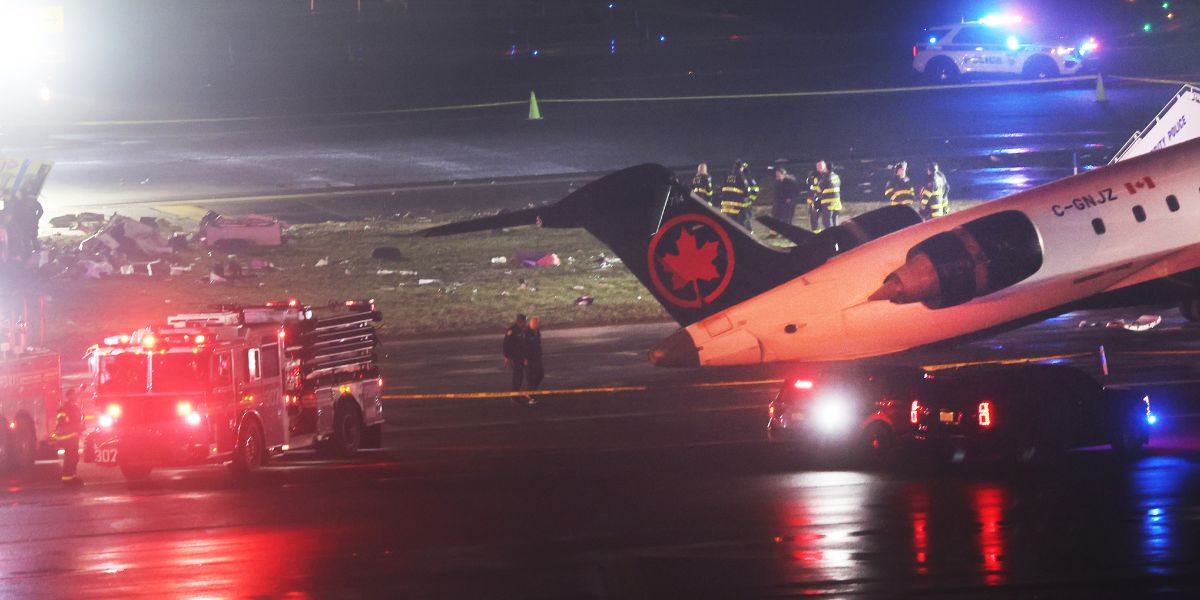
Emergency responders work at the scene where the Air Canada Express CRJ-900 sits on the runway after colliding with a Port Authority fire truck at LaGuardia Airport in New York City on March 23, 2026. | Source: Getty Images
Because what looked, on camera, like a sudden and senseless collision was apparently unfolding against the backdrop of an already active emergency. The airport wasn't dealing with a routine arrival; it was dealing with a developing crisis.
More than two minutes later, the pressure appears to remain unresolved.
At 6:25, the crew asked again, "2384, Do you have a gate available at this time? Otherwise we will be probably requesting gears here [sic]." At 6:31, the response was simply: "Give me one second."

The Air Canada Express plane sits on the runway after colliding with a fire truck at LaGuardia Airport in New York. | Source: Getty Images
Then came the exchange that now feels almost unbearable to read. At 6:45, emergency vehicles asked whether they were calling on the ground or the tower. By 7:00, Flight 2384 was reportedly cleared in lane eight, and at 7:03, it was told to proceed to the ramp.
Then, at 7:10, comes the ominous reference: "Truck 1." Just seven seconds later, someone says: "Truck 1, stop." That command lands differently once you've seen the video.

The aftermath of the plane collision with a fire truck at LaGuardia Airport. | Source: Getty Images
Because the social media footage appears to show the plane moving at speed just as the fire truck is crossing. There's no dramatic countdown, no visible warning for viewers, just a normal-looking runway scene that suddenly turns catastrophic.
After that, parts of the audio become fragmented, but the aftermath is devastatingly clear. At 10:17, one person says, "Alright, there's an incident on the field." Two seconds later comes the reply: "Yeah, we saw it, man."
The scale of the emergency quickly became apparent.

Passenger plane collides with a fire truck while landing at LaGuardia Airport on March 23, 2026. | Source: Getty Images
By 11:42, a transmission says, "Call us back at 10 minutes. There's incident on the field. The airport's closed right now [sic]." Later, at 18:08, another voice says, "We're not moving aircraft right now, all right [...] This could have been a big incident."
And then, perhaps the most gutting moment in the audio arrives much later. At 25:26, someone says, "Yeah, we got stuff in progress that's for that, man. That was...that wasn't good to watch."

A view of the plane and the first responder presence after the crash. | Source: Getty Images
Then comes a heartbreaking admission…
At 25:31, one person says, "Yeah, I know I was here. I tried to reach out to my stuff [sic], and we were dealing with an emergency earlier. I messed up." Another voice quickly answers, "No, man, you did the best you could."
Footage from the aftermath, as described by NBC New York, showed the emergency fire truck crushed against the nose of the plane. It's a brutal image, and one that underscores just how violent the collision was.
The circulated video footage is now drawing intense attention precisely because it appears to capture the final seconds before everything went wrong. And once you hear those stunned reactions — "Oh God" and "Oh my goodness, that's crazy" — it becomes even harder to look away.
For now, federal and local investigations continue as officials work to determine exactly how the aircraft and the emergency vehicle ended up on the same runway at the same time.
But between the desperate audio, the lack of a gate, the odor emergency, and the now-viral footage, this tragedy already reads like a chain of split-second decisions with devastating consequences.

Another view of the aftermath of the Air Canada plane incident on March 23, 2026. | Source: Getty Images
And if the audio and video footage convey the shock of the impact, the aftermath left behind it may be even more disturbing.
More details from BBC live revealed the aircraft, carrying 72 passengers and four crew members, had arrived from Montreal on Sunday evening, March 22, 2026, and was traveling at about 24 mph.

A traveler looks at canceled flight schedules on a screen at Terminal B in LaGuardia Airport in New York City on March 23, 2026. | Source: Getty Images
Meanwhile, a separate BBC update laid out the broader sequence of events. According to that timeline, the Air Canada flight departed Montreal at 10:12 p.m. ET, more than two hours behind schedule.
Minutes before 11:40 p.m., a Port Authority rescue and firefighting vehicle was dispatched to assist with a separate issue involving a plane at LaGuardia that had requested support. At about that same time, the aircraft collided with the truck on the ground while landing.

Port Authority representative gives press conference after an Air Canada Express plane collided with a fire truck at LaGuardia Airport in New York City. | Source: YouTube/NBC New York
Emergency crews responded right away after the impact. By 3:09 a.m., LaGuardia said the airport was closed because of the incident, and around 3:30 a.m., the first portion of the National Transportation Safety Board team arrived.
At 4:48 a.m., Port Authority Executive Director Kathryn Garcia said two Air Canada pilots had died, and nine people remained in the hospital. Two Port Authority police officers were also badly injured.

Port Authority representative gives press conference after an An Air Canada Express plane colliding with a fire truck at LaGuardia Airport on March 23, 2026, in New York City | Source: YouTube/NBC New York
Additionally, she said the airport would stay closed until at least 2:00 p.m. local time so investigators could continue processing the scene. Further updates said 41 passengers and crew members were taken to hospitals, along with two officers who had been inside the ground vehicle, while 32 of those hospitalized have since been released.
Authorities also warned travelers to brace for major disruption around the airport. The New York City Fire Department told the public to expect cancellations, road closures, traffic delays, and a heavy emergency presence near LaGuardia.
The chaos on the ground left stranded travelers trying to make sense of what had happened. In another BBC report, 26-year-old Katie Rojas said her flight to Chicago was already on the runway and prepared to depart when all planes were grounded.

Passengers wait outside Terminal B at LaGuardia Airport following its closure after a deadly runway collision in New York City. | Source: Getty Images
"It tried taking off twice and both times literally stopped in its tracks," she said, explaining that after two and a half hours on board, passengers were told they had to evacuate. She added, "They said there was a smell coming from the plane. I don't know if that was just something they were saying."
After returning to the terminal, Rojas said she saw emergency vehicles everywhere and only later learned about the crash online. She was first rebooked for a 7:00 a.m. flight that was also canceled, then placed on a 3:20 p.m. departure, but said security was closed and she had no way to check her bags.

Passengers speak with staff at a service desk at LaGuardia Airport following its closure. | Source: Getty Images
By that point, she had been waiting at the airport for 12 hours, hoping to finally get home. Reflecting on the crash, she said, "It's scary. You never know if it could have been one of us."
That context makes the audio even harder to hear. A fast-moving but controlled emergency response ended up with a runway shut down, lives lost, people injured and scared, an airport plunged into chaos, and a recording that now serves as a minute-by-minute account of how everything went wrong.
Antoine Forest, Jazz Aviation Hero Pilot, Sparked Buzz with Emotional Instagram Post – Photo
March 24, 2026
22-Year-Old Passenger Jack Cabot Stuns With His Account of What Unfolded Inside an Air Canada Plane at Laguardia – Video
March 25, 2026
New Details Emerge Following the LaGuardia Airport Incident That Claimed the Lives of Two Pilots
March 23, 2026
What the Pilots Might Have Seen Before the Collision at LaGuardia Airport
March 25, 2026

'Dancing With the Stars' Alum Charlotte Jørgensen Was Among the Passengers Aboard the Plane Involved in the Laguardia Incident
March 31, 2026

Solange Tremblay Seen Recovering in Hospital Following LaGuardia Airport Incident – Photos
March 30, 2026

Expert Reveals One Key Reason the Flight Attendant Likely Survived a 300-Foot Ejection in the LaGuardia Crash
March 25, 2026

Experts Reveal the Safest Plane Seats That Could Save Your Life in an Emergency
March 31, 2026

Denver Airport Incident Reveals Shocking Past of Man Behind Runway Tragedy
May 13, 2026

United Passenger Causes Chaos on Board – Audio Reveals What Happened
May 04, 2026
Pilot's Final Seconds Before Missouri Skydiving Plane Went Down Leave Investigators Searching for Answers — What the Evidence Shows
June 16, 2026