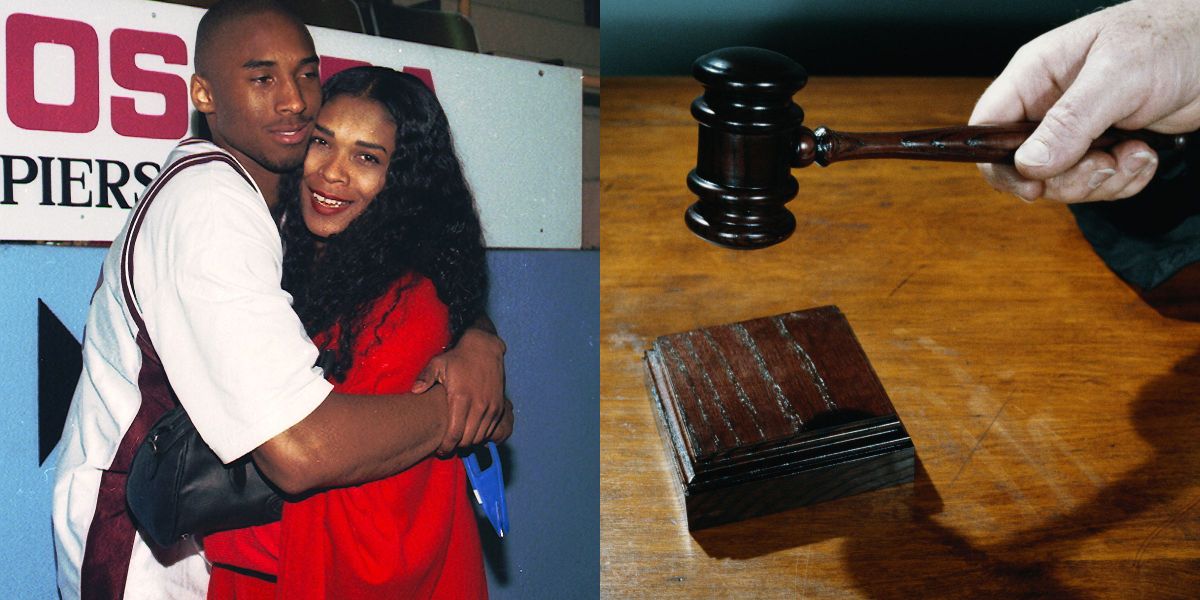
Kobe and Pamela Bryant | A close-up of a judge holding a gavel | Source: Getty Images
Kobe Bryant Took Legal Action After His Mother Received $450,000 to Sell His Memorabilia – The Family Dispute Explained

By
Milla Sigaba
Aug 12, 202610:00 A.M.
What began with plans to auction treasured pieces of his past soon escalated into competing lawsuits and sworn statements from members of his own family.
Advertisement
Kobe Bryant spent two decades building his legacy with the Los Angeles Lakers, but in 2013, pieces of that history became the subject of a family dispute that moved into court.

Kobe Bryant looks up at the scoreboard during the game between the Los Angeles Lakers and the Houston Rockets at Toyota Center in Houston, Texas, on January 8, 2013. | Source: Getty Images
At the center of the disagreement was a collection of memorabilia held by Kobe's mother, Pamela Bryant. The items stretched back to his younger years and included game-worn high school uniforms, varsity letters, and keepsakes connected to his NBA career.
Pamela entered into a consignment agreement with New Jersey-based Goldin Auctions, authorizing the company to sell more than 100 pieces.
Advertisement
Advertisement
The auction house advanced her $450,000, money that was intended to help purchase a home for Pamela and Kobe's father, Joe Bryant. However, there was one major point of contention: the late basketball player maintained that the memorabilia was his and that he had never authorized its sale.
The NBA legend and his wife, Vanessa Bryant, gave a sharply different account in sworn statements of their own.
Advertisement
The conflicting positions soon became a legal matter. Kobe took action against Goldin Auctions in California in an attempt to prevent the auction, while the auction house pursued its own case in New Jersey seeking permission for the sale to proceed.
Although the dispute centered heavily on what had happened between Kobe and Pamela, mother and son were not directly suing each other.

Pamela Bryant during game seven of the 2010 NBA Finals at Staples Center in Los Angeles, California, on June 17. | Source: Getty Images
Instead, the lawsuits involving the auction house hinged on a question that went to the heart of their disagreement: Had Kobe previously given his mother the memorabilia as a gift?
Advertisement
Pamela said he had. In a sworn statement, she maintained that Kobe had told her years earlier that she could keep the belongings because he no longer wanted them.

Kobe Bryant during the 2013 Global Games at the Mercedes-Benz Arena in Shanghai, China, on October 18. | Source: Getty Images
The NBA legend and his wife, Vanessa Bryant, gave a sharply different account in sworn statements of their own. According to the couple, the memorabilia had never been given to Pamela.
They said they had previously asked her to return the belongings because Kobe wanted to preserve them for his children. He also alleged that some items that had been inside his home came into the possession of Pamela and the auction company without his knowledge.
Advertisement

Kobe and Vanessa Bryant attend the Make-A-Wish Greater Los Angeles 30th Anniversary Gala in California on December 4, 2013. | Source: Getty Images
Before those competing versions could be tested at trial, however, the dispute changed course.
The competing claims meant the case involved far more than the monetary value attached to sports collectibles. The belongings represented different stages of Kobe's life and career, while the dispute rested on whether Pamela had acquired legal ownership of them.

Kobe Bryant during a game between the Los Angeles Lakers and the Golden State Warriors at ORACLE Arena in Oakland, California, on October 30, 2013. | Source: Getty Images
Advertisement
The $450,000 advance complicated matters further. Pamela had already used the money toward a new home, and if Kobe succeeded in stopping the sale on the basis that she did not own the memorabilia, repayment of that advance could have become an issue.
At the time, Goldin Auctions also said Pamela possessed hundreds of additional pieces collectively estimated to be worth at least $1.5 million. There were legal questions beyond ownership as well.

Kobe Bryant during a game between the Los Angeles Lakers and the Atlanta Hawks at Philips Arena in Atlanta, Georgia, on December 16, 2013. | Source: Getty Images
Because both sides agreed that Pamela had possessed the items for years, the timing of the basketball star's attempt to reclaim them potentially raised a statute-of-limitations issue.
Advertisement
Pamela's position was that the belongings had long ago become hers, while Kobe's account was that he had no reason to initiate legal proceedings simply because his mother had been storing items with sentimental importance to him.

Kobe Bryant during a game between the Los Angeles Lakers and the Toronto Raptors at Staples Center in Los Angeles, California, on December 8, 2013. | Source: Getty Images
Before those competing versions could be tested at trial, however, the dispute changed course. In June 2013, just one week before the matter was scheduled to go to trial in New Jersey, Kobe and Goldin Auctions reached a settlement.
The dispute drew strong reactions from people weighing in online, many of whom focused on Pamela's decision to pursue the sale despite her son's objection.
Advertisement

Kobe Bryant during a press conference at the Verizon Center in Washington, D.C., on November 26, 2013. | Source: Getty Images
The agreement dramatically reduced the collection that could be sold: roughly 90 percent of the memorabilia originally slated for auction was removed, leaving only six pieces.
Among the items permitted to remain were two of Kobe's high school uniforms and two rings commemorating the Lakers' 2000 NBA championship that had been presented to his parents.

Kobe Bryant puts his hand on the NBA championship trophy at the end of the Los Angeles Lakers' victory parade through downtown Los Angeles on June 21, 2000. | Source: Getty Images
Advertisement
Goldin Auctions president Ken Goldin believed the six approved pieces could still collectively fetch more than $500,000. For Kobe's 2000 NBA All-Star ring and certain other memorabilia, half of the winning bid was also set to go to charity.
The resolution came with a public statement from Joe and Pamela as well, and the couple acknowledged the effect the episode had had on their son. They shared:
"We regret our actions and statements related to the Kobe Bryant auction memorabilia. We apologize for any misunderstanding and unintended pain we have caused our son and appreciate the financial support he has provided over the years."

Pamela and Joe Bryant attend the Advancement of Blacks in Sports (ABIS) Champions and Legends Awards at Resorts World Las Vegas in Nevada on May 28, 2022. | Source: Getty Images
Advertisement
They also apologized to Goldin Auctions for its involvement and thanked the company for helping resolve the matter. As for Kobe, he declined to publicly discuss the settlement.
The dispute drew strong reactions from people weighing in online, many of whom focused on Pamela's decision to pursue the sale despite her son's objection. One person questioned the circumstances behind the disagreement while suggesting Kobe could have allowed the auction to proceed.

Pamela and Joe Bryant onstage during the Advancement of Blacks in Sports (ABIS) Champions and Legends Awards at Resorts World Las Vegas in Nevada on May 28, 2022. | Source: Getty Images
"Word, I agreed with you, there have to be more to the story. smh I hope kobe's parents isn't in a situation that they need money. If i was kobe I would let her sell the stuff though [sic]!" they shared.
Advertisement
Others were much more critical, as another commenter said, "He's bought his mom several homes. Clearly his mom has become completely spoiled. Honestly, I understand some parents might want to sell their kid's stuff."

Items used by Kobe Bryant and other sports legends on display at Action House in New York on April 4, 2024. | Source: Getty Images
"But if their kid wants to keep their memorabilia why not just let them keep it? If the stuff was not worth over a million dollars, I'm pretty sure Kobe would not be forced to be in some stupid legal battle with his mom over some memorabilia," they continued.
Another person shared, "The problem is not just 'buy her another house' Kobe has bought his mother multiple houses, his parents have been subsidized with enormous wealth. If his mother was not so greedy for more money, she would have backed off when Kobe asked his mother not to sell his memorabilia."
Advertisement

Basketball shoes autographed by Kobe Bryant on display at the official launch event and series premiere of "A Mile In These Shoes" at COMUNITYmade in Los Angeles, California, on July 28, 2022. | Source: Getty Images
A fourth commenter focused on the sentimental and personal nature of the collection, typing, "How dare you sell Kobe items for your own selfish needs. If Kobe earned them, and used the jersey, they belong to Kobe. Even if Kobe Gabe them to his mother, she should know better than that."
"At the very lease, I hope she would have informed Kobe on her plans, and give Kobe the chance to buy them back from her. I can't imagine my mom giving away or selling my memorabilia, and for money, shame-shame-shame [sic]," the netizen added.
Advertisement

The first jersey worn by Kobe Bryant in his NBA career on display at Sotheby's Auction House in New York on March 21, 2025. | Source: Getty Images
Another netizen reacted more briefly, commenting, "Wow what kinda of mother would do that smh [sic]." Ultimately, the settlement prevented a trial that could have required a court to decide whether Kobe Bryant had actually given the collection to Pamela.
Most of the contested memorabilia was withdrawn from sale, while a small group of pieces was allowed onto the auction block, bringing the legal confrontation to an end without a jury resolving the family's conflicting accounts.
Advertisement
Advertisement